This post was written by all-star CANTER volunteer and dressage trainer Arianna. A graduate of UC Davis, Arianna has shown dressage to Prix St. Georges and is a USDF Bronze and Silver medallist. Arianna has been volunteering with CANTER California since June of 2016 and interned with CANTER while she was an undergrad.
————-
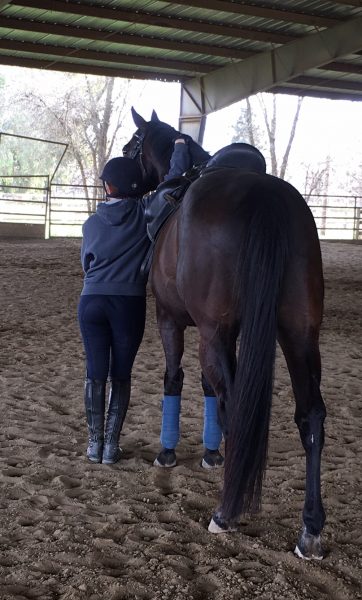
When I started riding Seafire for CANTER CA, I thought it would be a good way to get more time in the saddle (at the time I didn’t have a horse to ride), but I never imagined how much I would get back. Admittedly, this form of volunteering is almost selfish given how much I love horses, but it’s still amazing to know that I get to help horses coming off the track and get them ready for second careers. I also never imagined how much I would grow as a rider, all thanks to Seafire.
Seafire is a very special horse, which is what every horse-crazy girl says about her horse, but after having spent over a year and a half working with him, I can say with certainty that Seafire is something special. His quirks and personality have made him a challenge to work with at times but watching and feeling him figure things out is the ultimate reward. He has taught me an immense amount about the value of correct and patient training, with particular attention to understanding the feeling of the ride to find the next step in training.
Seafire is a very intellectual ride, by which I mean that I have spent a large quantity of time thinking about his personality and how to work with him. Nothing can be rushed, and everything must be one logical progression from beginning to end. He can take pressure well and learn new things, but he also used to crumble when he got corrected under saddle (he’s definitely made progress on this one!). He takes himself incredibly seriously (perhaps why we get along so well) and wants to work so much it’s almost ridiculous, but if he can’t figure out his job or thinks he’s getting something wrong, he can get anxious and worried. Simply due to the horse he is and the life he’s had, he presented a challenge in terms of retraining, but sticking him out has certainly been worth the wait.
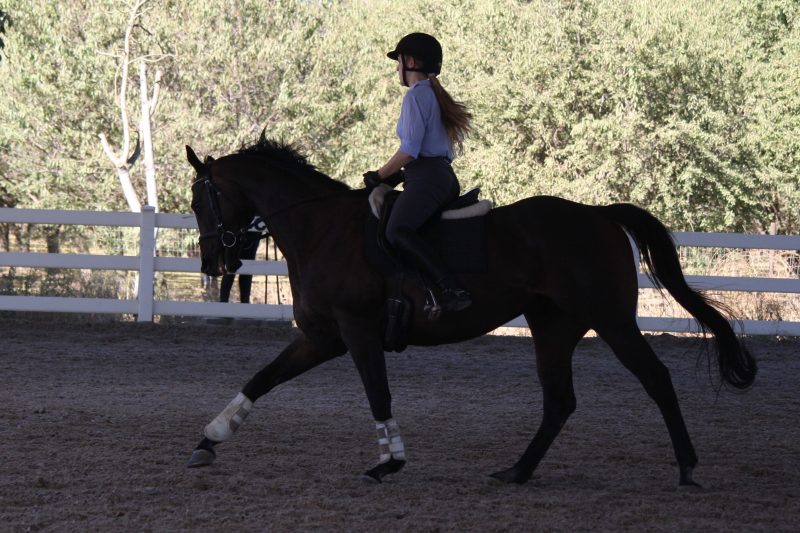
Slow, correct training of basics is so incredibly important, and Seafire has emphasized this in new ways. When I started riding him, I figured he was a relatively average Thoroughbred. He was pretty stiff but also pretty consistent throughout each ride. He went around quietly but didn’t know how to bend, and he certainly didn’t know what to do with contact. Over time that got easier, and he quickly figured out how to hold consistent contact, but the second I tried to give with just one rein, his head would snap the other way, and he would get anxious. Not ideal. From the beginning of working with him, I tried to focus more on how the middle of his body was working than what his face was doing (because clearly when I thought too much about his face, it wasn’t helping either of us. This would come back in a big way later). He quickly figured out bending and got more consistent with his canter transitions and leads, and at that point I felt like he would be a good riding horse with some pretty solid basics.
Although he was making progress, it was anything but linear (yay horses). Back in the summer of 2016, I had a trainer tell me Seafire was looking ready to start bringing his neck up higher and asking him to sit more (which definitely seemed like a logical next step), but when I tried to work on it, I just felt like he was getting too tense. So we went back to long and low work for a while. I also felt like he was rushing too much and that his front end and hind end were not matched up—he didn’t have schwung (he was tense, but mostly I noticed that his front and hind legs were not moving together so that each stride was a matched motion of hind leg pushing and front leg extending). So, we worked on simply slowing down and relaxing enough that his stride could be more methodical, and so that he could really take each step, rather than rushing through an exercise or a lap around the ring. Eventually this came through better in the trot, and I started feeling more like I could ask for more impulsion.
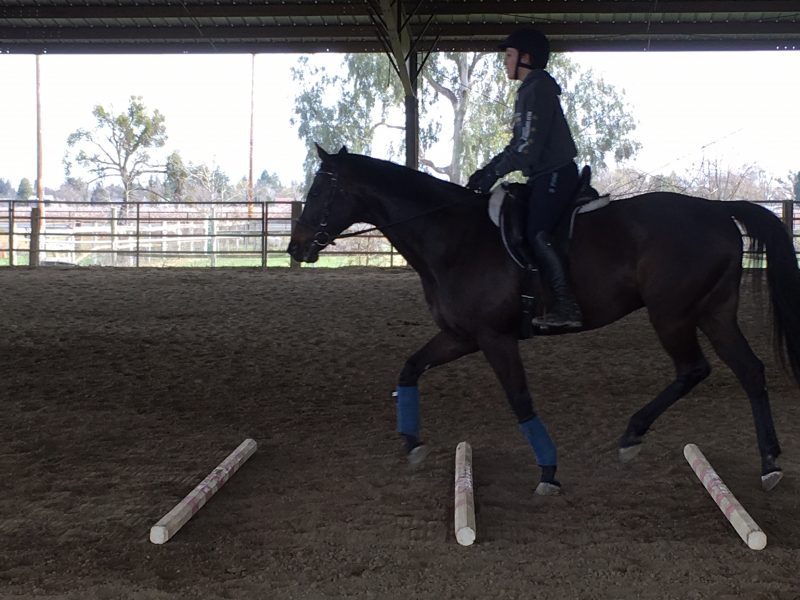
However, even while his trot improved and he came more honestly into the contact, I struggled with his canter. We had a consistent communication problem that came from some combination of him getting my number and me falling into a rut about how to help both of us work it out. I didn’t know what to do, and Seafire definitely didn’t either. He would consistently spook away from one corner/end of the ring, mostly going to the left, and everything I was trying to fix it just made it worse. A bigger bit made it easier to slow him down if he tried to rush off, but it also made him miserable. Lunging him in or near the problem end of the ring just made him a little frantic.
I decided to just back off (and tried not to think about it as giving up). I decided to just put Seafire in the round pen and try to work on communication for a few days. When he came to us, he didn’t lunge, so working on lunging was always more about figuring out how to make consistent circles and get the correct gaits/leads etc. With him in the round pen, I got a chance to work more on pressure and vocal cues. By the end of those few days, he was definitely listening better and had relaxed enough to nibble the plants growing in the ring. When we started working him again, I had Jody, one of our volunteer trainers, get on before I did, to see what she thought about the situation. She suggested just firmly ignoring his looks outside ring and looking up and around the corner to avoid giving him any chance to think I was staring at anything potentially suspicious. Surprise, surprise, not staring at his head and riding like we were going someplace worked (solving problems by yourself is hard, friends, so ask for help! Sometimes it’s the simple solutions).
As we worked with him, we had figured out that Seafire got a little claustrophobic—he was grumpier if there were multiple horses in the cross ties, and especially if there were lots of people around. During riding him, I had noticed that the stronger and more unyielding the contact was, the more upset he would get (and differently from how other horses might object to strong contact). So one day I wondered if it might work to simply have no contact at all.
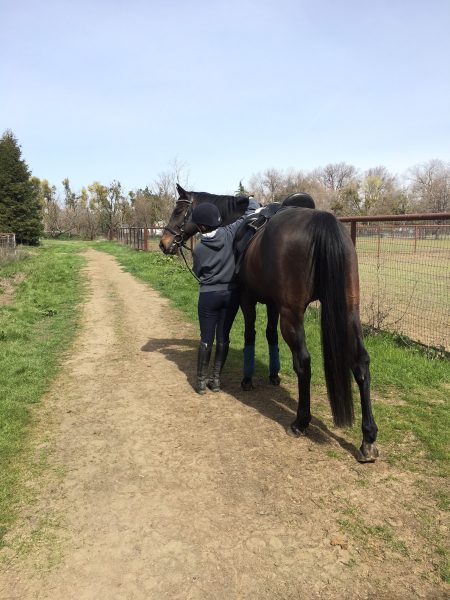
When you’re sitting on a thousand pound animal with a mind of its own, you want to think you’re in control of the situation, and reins seem like a great way to make that happen. In reality the only thing stopping horses from giving us the middle hoof and peacing out is the goodness of their hearts, and they really are better than we may give them credit for. The uncomfortable realization that my reins were probably pretty useless was setting in, and that also meant really committing to the fact that Seafire would behave.
One of the most difficult things I have ever had to do is to believe that if I didn’t take more contact, Seafire would stay with me. Convincing myself that having less contact on a horse who had just been rushing away from me was quite the task. However, it was an amazing ride, and he listened to everything I asked. One of the hardest things for me to learn was how to let go and believe that he would do his job. The hardest thing for Seafire was if I didn’t let go or believe he could do his job.
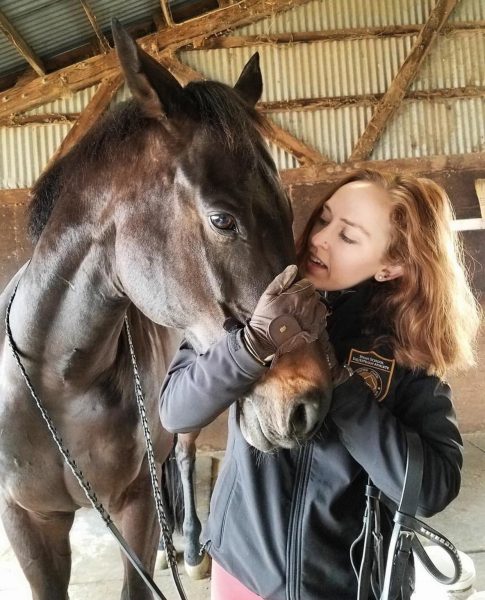
One of the biggest lessons I have learned from Seafire is that to get anything done, there must be mutual trust. With other horses I’ve ridden, that has been more of a given and simply being consistent and doing my usual routine has been enough to get them to believe in me. Seafire was a little trickier. As with any horse (or person), we all bring emotional baggage to the situation, and if some horses come with a bit, Seafire was the equine equivalent of one of those tourist families you see at an airport with trolleys of giant suitcases. Over the past few months, he has only gotten better and more correct in his acceptance of the contact and his willingness to work hard has not diminished. He has been feeling more able to carry himself and been carrying more weight behind at the trot and canter (which is really exciting!). This does not mean, however, that he is magically many steps ahead of where he was. There are still tough days and spooky days among the really good days. He is an excellent example of needing to ride what you get each day. Giving him the benefit of the doubt and taking your time each day will get you exponentially farther than getting frustrated about something in the moment.
To add to his updated CV, he has even given a few rides to other CANTER volunteers recently, giving them a taste of a more dressage-y horse. Watching him share his knowledge has made me so, so proud. He takes himself so seriously and tries so hard, but he also won’t just give it away, so he’s a great horse to learn things on as well (which is something I never thought I would say). He’s truly grown up into a wonderful horse.