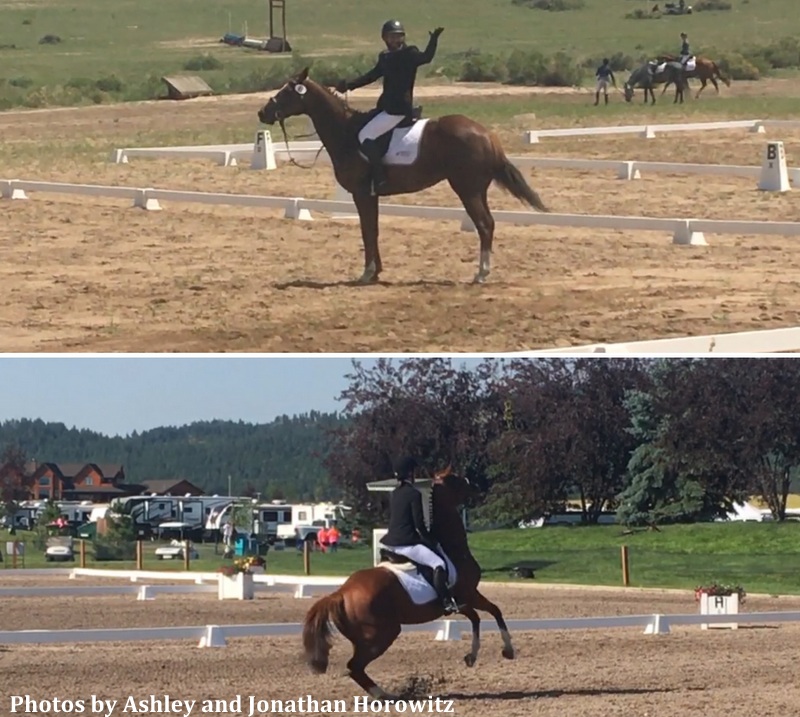
If horses could talk, this is what I imagine the responses would be if my wife and I asked each of our top event horses, “Can you do (fill in the blank with something we’d like our horses to do)?”
Ashley’s chestnut mare Tiny Dancer (JC: Emily’s Pegasus) would respond, “Yes, I’d love to!” There is definitely an exclamation point on the end of Sussy’s response to express her excitement about literally everything. That excitement sometimes results in overjumping a cross country fence by a foot, but she wants to do all the things.
My chestnut mare Sorority Girl (JC: Grand Moony) would respond, “I don’t know, can I?” There is definitely sarcasm on the end of Moo’s response. This is the response you’ve probably heard from a smartass child who may not want to do it and points out how the question only asks if she is able to do it, not that the person asking actually wants it done. Moo is opinionated and questions whether she has to do something.
My wife and I celebrated our one-year anniversary this month and are grateful to be living our dreams through our event horses. However, the path each of our top event horses has taken so that we can continue to chase those dreams has been very different. The lesson of this second part of the three-part mini series “Not Every Horse” that I’m exploring through this column is that horses, just like people, have very different personalities and learning styles. It’s crucial to take those into account when training a retired racehorse for a new career.
That may seem obvious, but when the evaluations of horses are based on their physical performance, the effects of the horses’ personalities on their learning styles may more prominently influence their physical progress than their actually physical ability.
A racehorse may have all the physical talent in the world, but without the desire to fight and go for a small opening on the rail, that horse’s physical talent won’t come out in its fullest. Most retired racehorses can physically do anything their riders will ever ask them to do. However, a trainer must bring it out in a way that matches a horse’s personality and learning style. Otherwise, the retraining will stagnate or possibly decline if horse and rider can’t get on the same page.